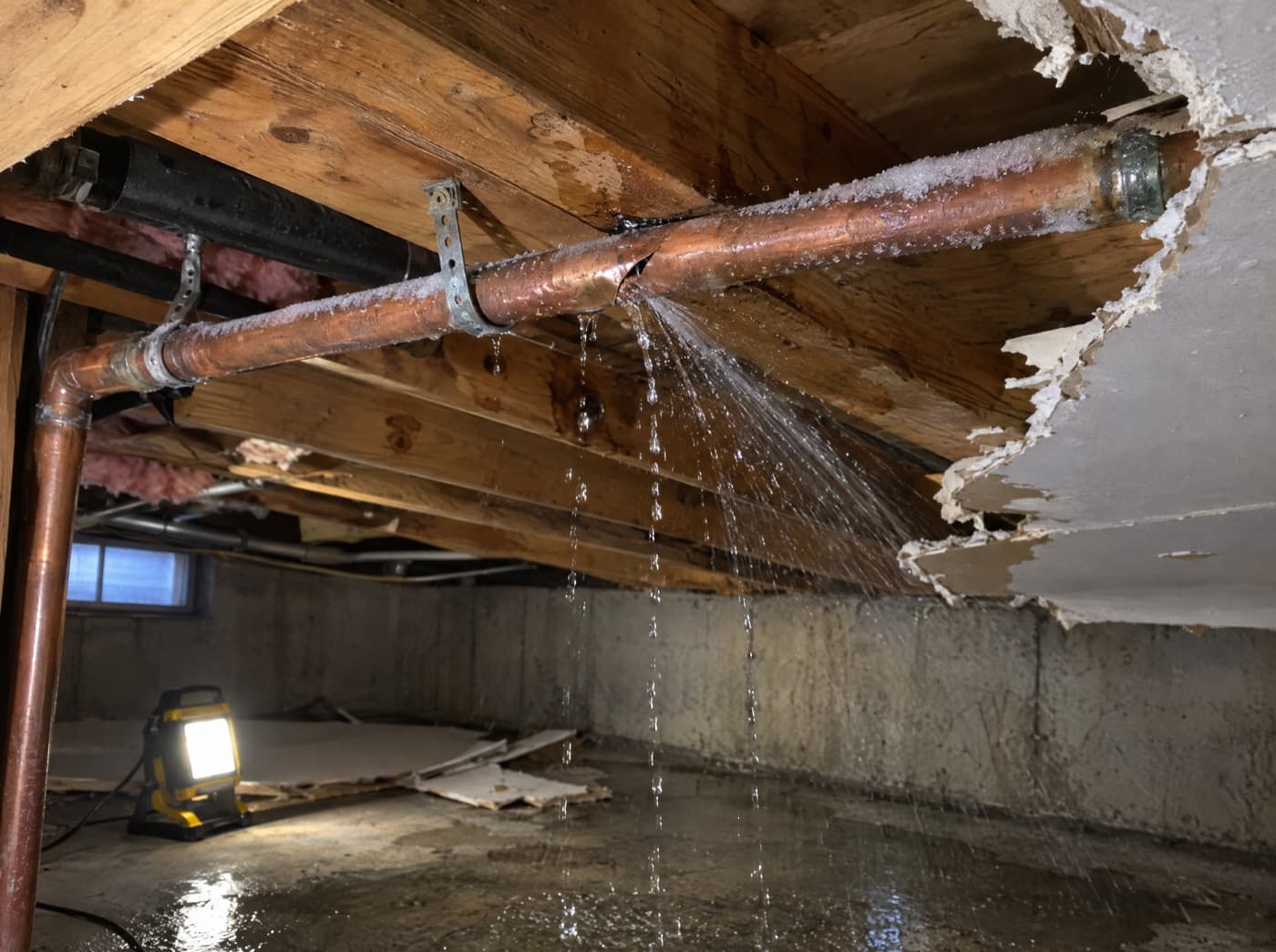
A burst pipe pushes clean water into a house at full line pressure, often several gallons a minute, until someone closes a valve. In Boulder, most bursts happen during a cold snap: water freezes in a pipe that runs through an exterior wall, a garage, or a crawlspace, pressure builds behind the ice, and the pipe splits. Many people don't find out until the thaw, when the water starts moving again.
Crews handle water damage claims from every major carrier, including:
State Farm
Allstate
USAA
Farmers
American Family
Liberty Mutual
Travelers
Nationwide
Insurers are named for reference only. We are not affiliated with or endorsed by any insurance company.
What to do in the next few minutes
Supply-line water starts out clean, which is the best case for restoration. Drywall, insulation, and subfloor can often be dried in place if extraction starts within the first day. Wait two or three days and the same water is treated as gray water, with more tear-out and antimicrobial treatment.
Water category:Category 1 (clean water) when caught early
1Close the main water shutoff, usually where the line enters the basement or crawlspace.
2Open a faucet on the lowest floor to drain pressure from the lines.
3If water is near outlets or a ceiling is sagging, stay out of that room and switch off its breaker only if you can do it from a dry floor.
4Photograph the split pipe, the wet areas, and anything damaged before you move it.
5Call a restoration crew before you call a plumber back. Drying should start the same day the leak is fixed.
How a certified crew handles burst & frozen pipes in Boulder
Step 1
Moisture mapping
The crew uses pin and pinless moisture meters and a thermal camera to trace how far the water traveled inside walls and under floors, which is usually farther than the visible stain.
Step 2
Extraction
Truck-mounted or portable extractors pull standing water out of carpet, pad, and subfloor so drying equipment can work.
Step 3
Controlled tear-out
Only materials that can't be dried, such as soaked insulation or swollen baseboard, come out. Drywall is often cut in a straight line about two feet up to open the wall cavity.
Step 4
Structural drying
LGR dehumidifiers and air movers are set up to IICRC S500 guidance, with readings taken daily until every material reaches its dry standard, typically in three to five days.
Step 5
Documentation
Photos, moisture logs, and an Xactimate estimate go to you and your adjuster, so the claim reflects what was actually wet.
Local notes
What Boulder homeowners should know
Boulder's freeze-thaw swings are hard on plumbing. Chinook winds can warm a January afternoon into the 50s before a hard freeze that night, and pipes in exterior walls, garages, and crawlspaces take the worst of it. Older homes in Mapleton Hill and University Hill often have supply lines in poorly insulated outside walls, and many split-level homes in Table Mesa and Martin Acres run lines through crawlspaces.
Insurance
Will insurance cover it?
A burst pipe is the textbook covered loss on a standard HO-3 homeowners policy: sudden and accidental discharge of water from a plumbing system. Drying, tear-out to reach the leak, and repairs are typically covered after your deductible. The broken section of pipe itself usually is not, and freeze damage can be denied if the home was left unheated without the water shut off and drained.
Should I call a plumber or a restoration company first after a pipe bursts in Boulder?
Shut off the water yourself, then call both. The plumber fixes the pipe; the restoration crew removes the water and dries the structure. Drying is the time-sensitive part, so don't wait for the repair to be finished before getting extraction started.
Can drywall be saved after a burst pipe?
Often, yes. If the water was clean and drying starts within about 24 to 48 hours, drywall that hasn't swollen or lost strength can usually be dried in place. Insulation behind it is often removed because it holds water.
How do I keep pipes from freezing again?
Keep the heat at 55°F or higher, open sink cabinets on exterior walls during cold snaps, let those faucets drip, disconnect garden hoses, and insulate pipes in crawlspaces and garages. If you'll be away for more than a couple of days in winter, shut off the main.